Week 11 – Learning Skills and Surveying/Geospatial Careers

LEARNING STYLES & EMOTIONAL LANGUAGE

“Tell me, Ill forget

Show me, Ill remember

Involve me, Ill understand”

Understanding this is another effective way of communicating. Engineers and surveyors spend 60% of their career communicating. Learning styles differ person to person, therefore the method of communicating data should be tailored to suit the majority of the audience.

VISUAL

AUDIBLE

KINESTHETIC

This presentation was interesting for me as I began to think about how the effectiveness of these learning methods is actually a cross with the communication presentation. To start with, no method of education will be effective if not properly communicated. This however is not necessarily communication from a teacher to a student though. In my case the most effective way to learn is to teach it to somebody else. When doing this it forces me to think through what I am actually trying to communicate and therefore commits it to memory far more effectively.

TOM HOLLANDS – SPATIAL VISION & CHRIS POWELL – CAT

I have combined my assessment of these two presentations because I feel like they both were trying to convey the same message, the importance of interviews and trusting yourself. Both Tom and Chris have had a variety of different jobs before landing where they are today and both attribute this movement and variety to their end success. Chris especially stated that if he hadn’t applied and interviewed for as many different jobs as he had, then he wouldn’t have been as practiced by the time he got to the CAT grad interview. This practice in turn developed a confidence that allowed Chris to promote his best self for the position.



Week 10 – Personality Typing and Teamwork, and Surveying/Geospatial Careers

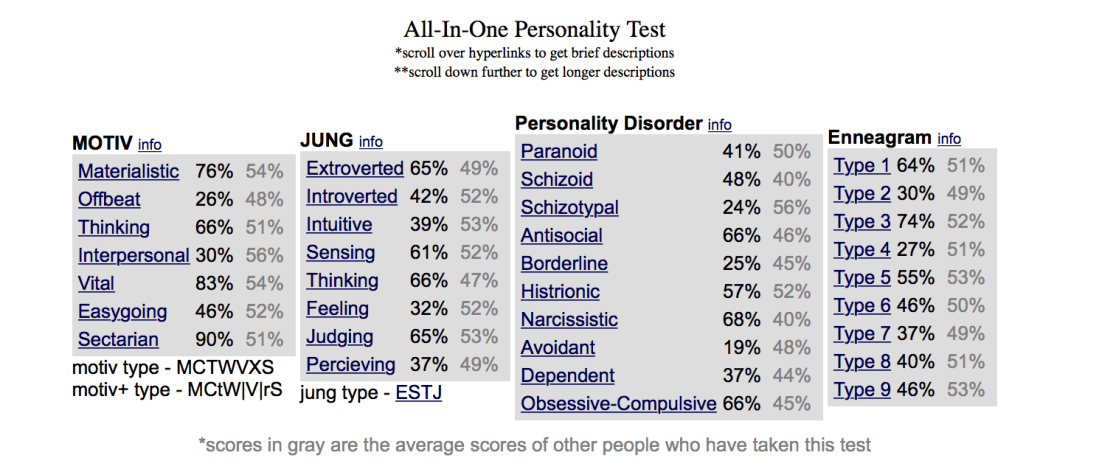
We were advised prior to the week 10 class to undertake an online personality test. My results are shown below.Screen Shot 2018-10-23 at 10.01.25 pm

Understanding different personality types can give people in a workplace a large advantage over those who don’t. Mainly it can avoid mis communication and mis interpretations by understanding how people think, and expect to be thought about. I feel like in a workplace it could be interpreted as slightly invasive to have people undertake this test and share the results with you. However having a basic understanding of these personality types can assist in making informed decisions about a person from the outset.

Braith McClure – (AAM)

Braith in my opinion was the most interesting speaker we had for the whole semester. Firstly his ability to address and capture the audience was amazing. Following that was his content. The projects AAM are undertaking such as the building in Sydney that will move under the weight of its own construction. Braith really highlighted the value in people who can think out of the box and problem solve.


Taylor Brennan – (Coles)

Taylor was an RMIT graduate who floated around a few different things before landing at Coles. Coles uses geospatial data in order to target sales and store opening locations to target desired demographics. Aside from this I feel that Taylor’s presentation got a bit off topic and wasn’t of a great deal of interest to me.


Week 9: Survey Audits and Business Practices

Colin Hall – Senior Surveyor in the Office of the Surveyor-General of Victoria

Colin dressed the survey audit program and how it was undertaken. The audits are actually based on the surveyor individually not the company they work for. Therefore if you get a bad reputation, it does not matter which company you move to, that bad reputation will follow you there.

I found it interesting how often audits actually failed and were not up to standard. Although it has dramatically improved in the last decade it is still only at 91% satisfaction. Which may sound very good but 1 out of 10 surveys being submitted that can adversely effect the cadastre is a large number in the scheme of things.

Leo Bateman – Taylors

Leo had an interesting change of pace with his topic by encroaching business operations as a whole rather than just talking about the surveying. This was actually quite interesting. I think the most relevant point he made is that we as uni students could come out of our education in the wrong mindset. He made it very clear that a pass mark at university would not be sufficient at work. Being right and accurate in a work environment 50% of the time is not satisfactory, at Taylors they are aiming for 100% success rate.

Leo also touched on communication for the second time in the semester. Once again with an extra interesting addition. The insight on how to deal with problem clients was quite valuable. The main thing i grasped from this was not just to ignore them, but be quick in response and aim to fulfil their needs as quickly as possible as a method of moving them on. Also this is something you can never take personally, it must be treated as just business.

WEEK 8 – Alternative Dispute Resolution

Rebecca Leshinsky – Barrister

I found this to be one of the most interesting and useful presentations of the semester.

ADR is the dealing of conflicts and disputes, similar to litigation. In a general sense it is used before litigation but in many cases also applies post litigation. Usually involves the use of a 3rd party to help mediate the situation. It is good way to avoid the risks and costs of litigation. Also results in a happier resolution as both parties must agree. Essentially is compromise.

I never realised how many alternatives were available that were widely accepted. It seems like in most scenarios if you can get the parties involved to agree to one of the following methods then you will achieve a happier outcome.

NEGOTIATION –

  • Authority needed to settle without a client
  • Consider options of both sides
  • Consider a compromise
  • How will communication be undertaken
  • What is the desired outcome


MEDIATION –

  • Used for a variety of conflicts
  • Used in conflicts where no future planning is needed
  • Drawn from all careers
  • Can take hours or centuries

CONCILIATION –

  • The councillor can only hold an advisory role
  • Councillor must be impartial

ABRITRATION –

  • Chosen by the parties involved
  • Essentially treated like a court case
  • Arbitrator makes the final determination that cannot be undone

Susanne Tepe – OHS

From Susanne Tepe’s presentation I didn’t learn much in regards to what the actual risks involved in our line of work were but the real value came from how to properly deal with these risks before they can become imminent.

Not only is it important to reduce the risk for your own safety but also from a legal standpoint. As a business if you do not do everything in your power to enhance the health and safety of your employees then you are far more liable when any safety issues occur. Therefore it is important to have as many measures as possible addressed no matter how menial they seem.

A lot of this came down to risk assessment forms and risk management forms to be completed before any work in the field is undertaken. These forms should be tailored to suit each job and account for the different risks that may be encountered. Another important piece of paperwork to complete is a JOB SAFETY ANALYSIS. Which can be found as a generic sheet on line and tailored to suit on the job.


WEEK 7 – COMMUNICATION

Effective communication is the key to success in all aspects of life. Not only verbal, but non verbal just as important. i.e eye contact, listening to what they are communicating etc.

The most important thing I took from the communication presentation was not as much to do with communicating well but how to avoid communicating poorly. It seems all issues that arise from communication are when a piece of information is either miscommunicated or missed completely. Below is a clear set of guidelines of what to do and what not to do.

  • Formal Written Communication

  1. Always follow a template if there is one
  2. Spelling and Grammar
  3. No abbreviations
  4. Check for homonyms
  5. No contractions
  6. Be careful with colloquialisms
  • Informal Written Communication

  1. Don’t drop your standards
  2. Etiquette to be respected
  3. Many web based resources for the etiquette
  4. Rules such as copy write still apply
  •  Verbal Communication

  1. Start at the start
  2. Concise
  3. Assertive
  4. Empathetic
  5. Active Listening
  6. Open ended questions
  • Non Verbal

  1. Facial Expression
  2. Eye contact
  3. Hand gestures
  4. body posture
  • Physical space

  1. Personal space
  2. Face to face
  3. Physical contact

RICS PRESENTATION – MARK SHORTIS

Royal Institute of Chartered Surveyors – essentially an organise to use if you wish to have a working holiday.

There was then presentations from  Frazer Wilson (SSSI) & Adele Thomson (ISV). I did not feel there was much to write from these as they were mostly promotional for their respective companies.


Week 5 – Quality Management and Workplace Contracts

QUALITY MEASURES-

  • Product based
  • User based
  • Relativity based
  • Review based
  • Manufacturing based
  • Value based

Quality is perception based. Meaning that what some people may believe to be a high quality may not be regarded as high quality by others. That is why a lot of industries will set a standard, such as ISO9000.

Monitering quality can form an entire industry on its own. It can be very hard to maintain quality even when you are directly involved in the process or product. Independent testing is always a good option to ensure you keep a good level of control over your quality.

ISO9000 is the most widely used quality management and accreditation system. It consists of three core standards ISO9000, ISO9001 & ISO9004

CORE REQUIREMENTS OF ISO9000

  • Determine the needs and expectations of customers and other interested parties,
  • Establish policies, objectives and a work environment necessary to motivate the organisation to satisfy these needs,
  • Design, resource and manage a system of inter-connected processes necessary to implement the policy and attain the objectives,
  • Measure and analyse the adequacy, efficiency and effectiveness of each process in fulfilling its purpose and objectives and
  • Pursue the continual improvement of the system from an objective evaluation of its performance.


Unfortunately ISO9000 can require large amounts of work to gain accreditation for but may yield little result in actually improving quality. This is why in a lot of situations it is used by companies as a marketing tool.


Oscar Machen (Professionals Australia)

Oscar came in to talk about Professionals Australia, which is essentially a union. Oscar discussed a few scenarios industry professionals are faced with and how they should be handled. I unfortunately didn’t find much benefit in this presentation.

Week 6 – Risk Management and Professional Indemnity

ACSIS –  Australian Consulting Surveyors Insurance Society

Insurance needs of surveyors include but are not limited to the following-

  • PROFESSIONAL INDEMNITY
  • PERSONAL INJURY
  • PRODUCT LIABILITY
  • WORKERS COMPENSATION 
  • PROPERTY DAMAGE
  • MOTOR VEHICLE
  • DEFAMATION
  • POLLUTION

ACSIS is a group set up with the thoughts of providing surveyors with the coverage they need in all scenarios. This is not just insurance but also risk management and indemnity claim support to name some others.

The presentation centred around risk management and how it should be dealt with in an organisation.

PI INSURANCE –

One small form of risk management, transfers the risk from you to an insurer. This does not negate the risk just reduces the impact. It is important to decide what level of cover is needed. Some clients may insist on a certain level of cover, in order to cover the project in the case of a mishap. Many factors considered when calculating premiums including, type of work, history and amount of cover required.

Litigation can arise from errors in field work, errors in reports, omitted information, too much information, failure to meet time constraints etc. Construction setout is the main error.

ROLE PLAYING SCENARIO –

We then undertook a role playing scenario as a class in which there was a mis-communication between a site foreman of a company who departed and a surveyor. It was very interesting to see that even though the construction company was mainly at fault that the surveying company was still partially liable for not following all protocol correctly and not having correct documentation.


Professional Practice – Lecture 4

PUBLIC SPEAKING

Very important to give an overview, especially in a formal setting. Very important for networking. Lectures are not a good example of pubic speaking, they aim more to convey large amounts of information efficiently

FOUR STAGES OF PRESENTATION

  1. Icebreaker
  2. Explain what you are going to say (possibly some banter)
  3. Say your content
  4. Summarise (optional)

Appearance is very important, not just the way you dress but also the way you present yourself i.e confidence, tone of voice etc. Be very wary of overdressing as well as underdressing.

Gauge your audience, what level of prior knowledge do they already have? Make sure you initially thoroughly introduce the topic to ensure everybody in the audience understands your speech.

Very important to fit your allotted time frame.


DUNCAN BROOKS – SMEC

Initially talked about the large conversion to digital, the ability for mass storage.

All maps have an agenda

  1. Content
  2. Style
  3. Projection
  4. Scale


LECTURE 2 – 25.07.2018 EVAN JENKINS s3529736

John Buckeridge – guest speaker

image

INTRODUCTION – John began by addressing the idea of differences between ethics and morals, and where the line is drawn. It was concluded that ethics refers more to a professional environment whereas morals are more of a personal, wholistic idea. An example in the Surveying world is data integrity. Watch “THE INSIDER”.

  • Exercise of utility
  • Environmental impact assessment
  • Politics and obligation
  • Utility in preparing a report
  • Honesty in preparing a report
  • Ranking values

Main focus revolves around the idea of what is prioritised and what is sacrificed in order to achieve projects. Idea of managing cane toads by introducing juveniles into areas before the adults reach the area. The issue raised is that cane toad populations will go through the roof due to less animals being predators for them. Is it important for us to consider our great great great grandchildren or is that not in our scope of concern.


Mark Shortis – regular speaker

image-2

  • Very important to approach companies that have a quality assurance process.
  • Surveying job application process will most likely be far less formal than a lot of other industries due to small nature of industry.
  • Important to not negotiate until a job offer has been made, then you are negotiating from a position of power.
  • Job applications need to be tailored to the role in question, otherwise information will be irrelevant and application will be brushed over.
  • Discuss projects you have been involved in that are related to the job at hand, while remaining relevant
  • STAR method (SITUATION, TASK, ACTION & RESULTS)


Professional Practice – WEEK 3 EVAN JENKINS s3529736

Interviews –  Mark Shortis

Interviews not only want to know your work skillset but who you are as a whole. It is important to re-read the advertised job numerous times to make sure you are able to fill all job requirements adequately. Don’t be nervous, this displays doubt to the employer.


There can often be more than one interview. The interviews will be in rounds, progressing up to high skill tests, medical tests or meetings with the CEO.

GUEST SPEAKER – Craig Sandy

CraigSandy-0181-374x335

Craig really emphasised the importance of youth in the industry. He made it abundantly clear that the average age of high level professionals in surveying was far too high and was going to cause issues in the future with the way technology will advance.

A job is mere than just the technical content of the role, its also many other factors within a company.

Interview should go both ways, not only the employer finding about about you but also if the company is a good fit for you.

Many different pieces of legislation to consider.

Read Cadastre 2034 and Elevation and Depth 2030**

Cant have a 3D cadastre due to lack of definition for heights.

0418 387 183

craig.sandy@delwp.vic.gov.au